Table of Contents
Open Table of Contents
Overview
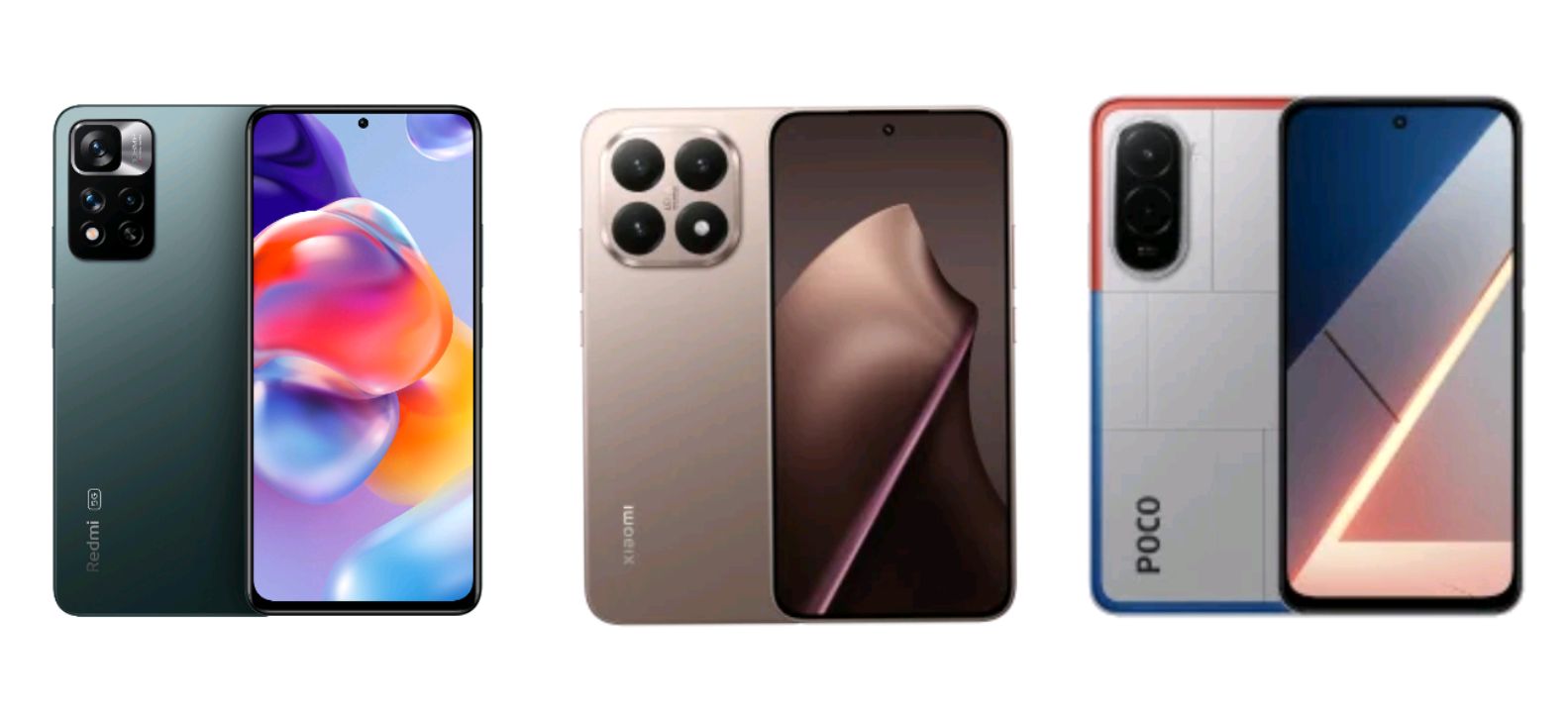
If you’ve spent any time shopping for a phone out of a Lagos electronics market or scrolling Jumia listings, you’ve probably noticed the same two names keep showing up next to each other: Redmi and Xiaomi. Some buyers assume they’re rival companies. Others assume it doesn’t matter which name is on the box. Neither is quite right.
Join ReviByte Community
Get instant alerts on new posts, phone deals, and mobile gaming updates.
Join WhatsApp ChannelSame parent company, different product strategies
Redmi didn’t start as an independent company. According to Xiaomi’s own brand history, Redmi launched in July 2013 as a budget smartphone line inside Xiaomi, and it only became a standalone sub-brand in January 2019. The split followed a pattern other manufacturers had already tried — Huawei had done it with Honor, and BBK would later do it with realme sitting alongside OPPO and vivo. Xiaomi Corporation’s own materials describe Redmi and POCO as separate brands within a broader multi-brand strategy.
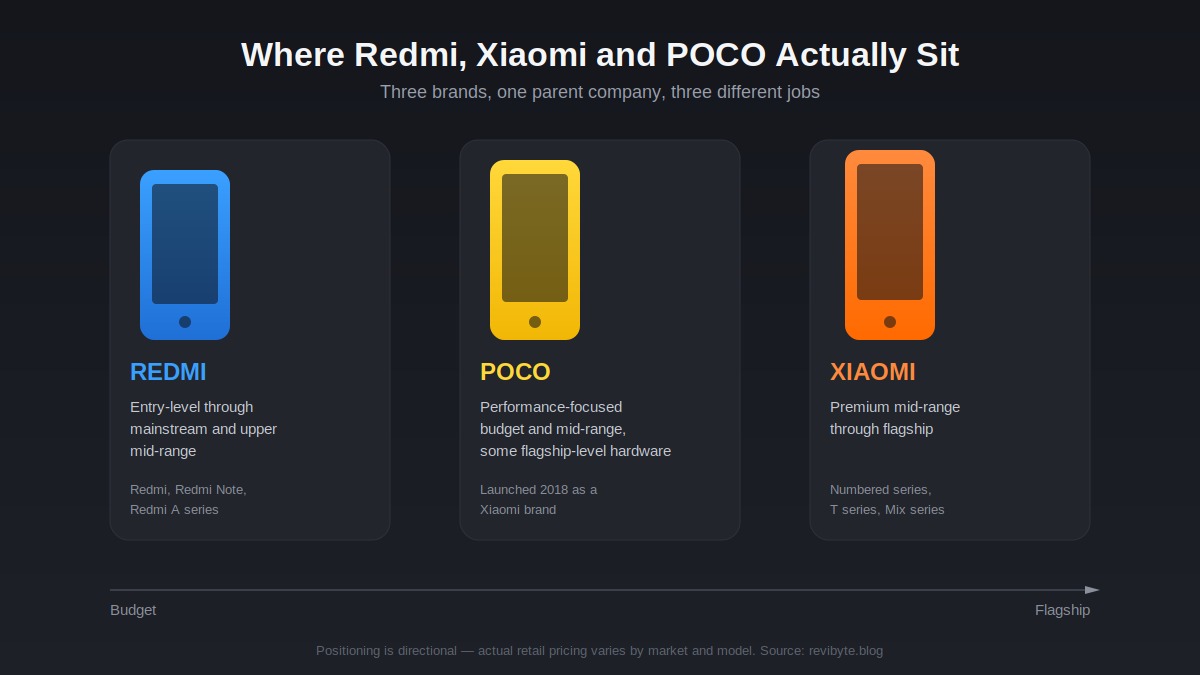
After the 2019 reorganization, Xiaomi increasingly positioned its own-branded phones toward the premium and flagship segments, while Redmi focused more heavily on affordable and mainstream devices. POCO, which launched in 2018 as a Xiaomi brand, took a different approach: pairing relatively powerful hardware with aggressive mid-range pricing. Some POCO models have also been closely related to, or globally rebranded from, Redmi K-series devices sold in China, but POCO itself predates Redmi’s split into a standalone sub-brand.
Quick comparison
| Brand | Typical positioning |
|---|---|
| Redmi | Entry-level through mainstream and upper mid-range |
| Xiaomi | Premium mid-range through flagship |
| POCO | Performance-focused budget and mid-range, with some flagship-level hardware |
Actual retail pricing for each brand varies substantially by market and by which model in the lineup you’re looking at, so treat this as positioning rather than a fixed price ladder — always confirm current pricing before buying.
Where the line gets blurry
The tidy “Redmi is budget, Xiaomi is premium” split isn’t absolute. Some Redmi Note models can offer camera hardware that overlaps with cheaper Xiaomi-branded phones, because Redmi’s stated strategy — per Xiaomi’s own positioning — is to use less expensive components elsewhere on the phone (build materials, secondary sensors, charging bricks) while keeping the headline spec that shoppers actually compare in the wild, like the main camera resolution or the display refresh rate, competitive. That’s a deliberate design choice, not an oversight.
If cameras are the deciding factor for you specifically, it’s worth reading our deeper breakdown in Xiaomi Cameras Compared: Redmi vs POCO vs Xiaomi, which goes sensor-by-sensor rather than brand-by-brand.
Software: this is the one place they don’t differ
Both brands use Xiaomi HyperOS on top of Android. The interface and core software experience are therefore broadly similar, although update timing and feature availability can vary by model and region. There isn’t a separate Redmi version of HyperOS; the core interface is shared, although individual features can vary by model and region.
Battery life doesn’t split cleanly along brand lines either
This is a common assumption worth correcting: buyers often expect Xiaomi’s premium phones to automatically outlast budget Redmi phones, but that’s not how it plays out in practice. Battery capacity and efficiency are decided per model, not per brand, which is exactly why we keep a running list of Xiaomi phones with the longest battery life and a separate list of POCO phones ranked for battery life rather than assuming one badge wins by default.
If you’re cross-shopping outside the Xiaomi ecosystem entirely, vivo’s phones with the best batteries in 2026 and TECNO’s 2026 lineup are both worth a look at similar price points before you commit to either Redmi or Xiaomi.
So which one should you actually buy?
Instead of picking a “winner,” it’s more useful to match the badge to what you actually need:
| If you want… | Go with |
|---|---|
| The lowest possible price for a usable smartphone | Redmi A series or entry-level Redmi |
| Balanced specs and a bigger screen without flagship pricing | Redmi Note series |
| Flagship-adjacent hardware at a mid-range price | POCO |
| Premium cameras, displays, and materials | Xiaomi flagship/numbered series |
FAQ
Is Redmi a cheaper, lower-quality version of Xiaomi? Not exactly. Redmi phones are built to a lower price point, which does mean cost-cutting somewhere — usually in build materials or secondary specifications — but the brand isn’t simply a downgraded Xiaomi. It’s a separate product line with its own design targets.
Do Redmi and Xiaomi phones run different software? No. Both run Xiaomi HyperOS on Android, and the interface and core experience are broadly the same. Update timing and feature availability can still vary by individual model and region.
Is POCO the same as Redmi? POCO is a separate Xiaomi sub-brand. Some POCO models have been closely related to, or globally rebranded from, Redmi K-series devices sold in China.
Which brand has better cameras, Redmi or Xiaomi? Xiaomi’s higher-end models generally carry more advanced camera hardware, while Redmi often prioritizes the main camera specification while making compromises elsewhere to hit a lower price. See our full camera comparison for specific model breakdowns.
Are Redmi phones sold under the Xiaomi name in some countries? Historically, yes — before the 2019 split, budget Xiaomi phones simply carried the Redmi name as a sub-line. Today the two are marketed and sold as distinct brands nearly everywhere, including in Nigeria.
Does buying Xiaomi over Redmi guarantee a longer-lasting battery? No. Battery performance depends on the specific model’s capacity and chipset efficiency, not on which of the two brand names is on the box.
Related reading
- Best POCO Phones for Battery Life in 2026 — how Xiaomi’s performance-focused sub-brand stacks up on endurance.
- Xiaomi Cameras Compared: Redmi, POCO, Xiaomi — a sensor-level look at how camera hardware actually differs across all three badges.
- Xiaomi Phones With Long Battery Life in 2026 — the Xiaomi-branded models worth considering if endurance is your top priority.

Comments 0
Leave a comment