
Table of Contents
Open Table of Contents
Overview
Most “best gaming phone” roundups quietly assume a $600 budget, and quite a few “under $250” lists include phones that stopped selling for $250 the moment the article went live. The Poco X6 Pro is a good example — it’s a genuinely strong gaming chip, but it’s been retailing between $300 and $490 for most of 2026, not under $250. So this list sticks to phones with a documented street price under $250 at the time of writing, sourced from retailer listings and pricing aggregators rather than launch-day MSRPs.
That distinction matters more than the number printed on a spec sheet, too. A chipset can post a strong benchmark score in a cold run and still drop frames the moment sustained load kicks in during a long PUBG Mobile or Mobile Legends session. Below is a rundown of five phones that hold up under $250, what makes each one tick, and where each one falls short.

How These Phones Were Evaluated
Phones were shortlisted from manufacturer spec sheets and cross-checked against GSMArena, Kimovil, and Smartprix listings for chipset, GPU, RAM/storage type, and display specs. Selection criteria, in order: a verified street price under (or close to) $250 as of July 2026 rather than launch MSRP; GPU and CPU core composition suited to sustained gaming load rather than peak benchmark scores; display refresh rate matched against realistic in-game frame rates; software update commitment; and battery capacity relative to screen size. Where a chipset varies by region — the Galaxy A16 5G being the clearest example — both variants are noted rather than only the one more common in a single market.
Note: gaming performance expectations here are based on a mix of manufacturer specifications, independent reviews, benchmark databases (GSMArena, NanoReview, Notebookcheck), and reported thermal behavior in extended sessions — not hands-on testing of every unit. Actual frame rates will vary by game version, graphics settings, ambient temperature, and software updates, so treat the performance notes below as expectations rather than guarantees.
Quick Comparison
| Phone | Chipset | RAM / Storage (base) | Display | Battery | Street Price (USD) |
|---|---|---|---|---|---|
| Poco M7 Pro 5G | Dimensity 7025 Ultra | 6GB / 128GB, UFS 2.2 | 6.67” AMOLED, 120Hz | 5,110mAh | ~$226 |
| Redmi Note 14 4G | Helio G99 Ultra | 6GB / 128GB, UFS 2.2 | 6.67” AMOLED, 120Hz | 5,500mAh | ~$143–$199 |
| Samsung Galaxy A16 5G | Exynos 1330 (most markets) / Dimensity 6300 (India, Thailand) | 4GB / 128GB, UFS 2.2 | 6.7” Super AMOLED, 90Hz | 5,000mAh | ~$148–$200 |
| Tecno Spark 40 | Helio G81 | 4GB / 128GB, storage type undisclosed by Tecno | 6.67” IPS LCD, 120Hz | 5,200mAh | ~$110–$150 |
| Redmi Note 14 5G | Dimensity 7025 Ultra | 6GB / 128GB, UFS 2.2 | 6.67” AMOLED, 120Hz | 5,110mAh | ~$173–$250 |
Prices are representative street prices collected from retailer listings and price aggregators (GSMArena pricing aggregation, Kimovil, Smartprix) in July 2026 — a point-in-time snapshot, not a live feed. They vary by region, storage tier, and ongoing sales, so treat this table as a performance ranking rather than a fixed price list — always check current listings before buying, particularly for the Redmi Note 14 5G and Poco M7 Pro 5G, whose upper configurations can cross $250.
What Actually Makes a Budget Phone Good at Gaming
Three things decide whether a cheap phone survives a real gaming session, and none of them is the number on the box.
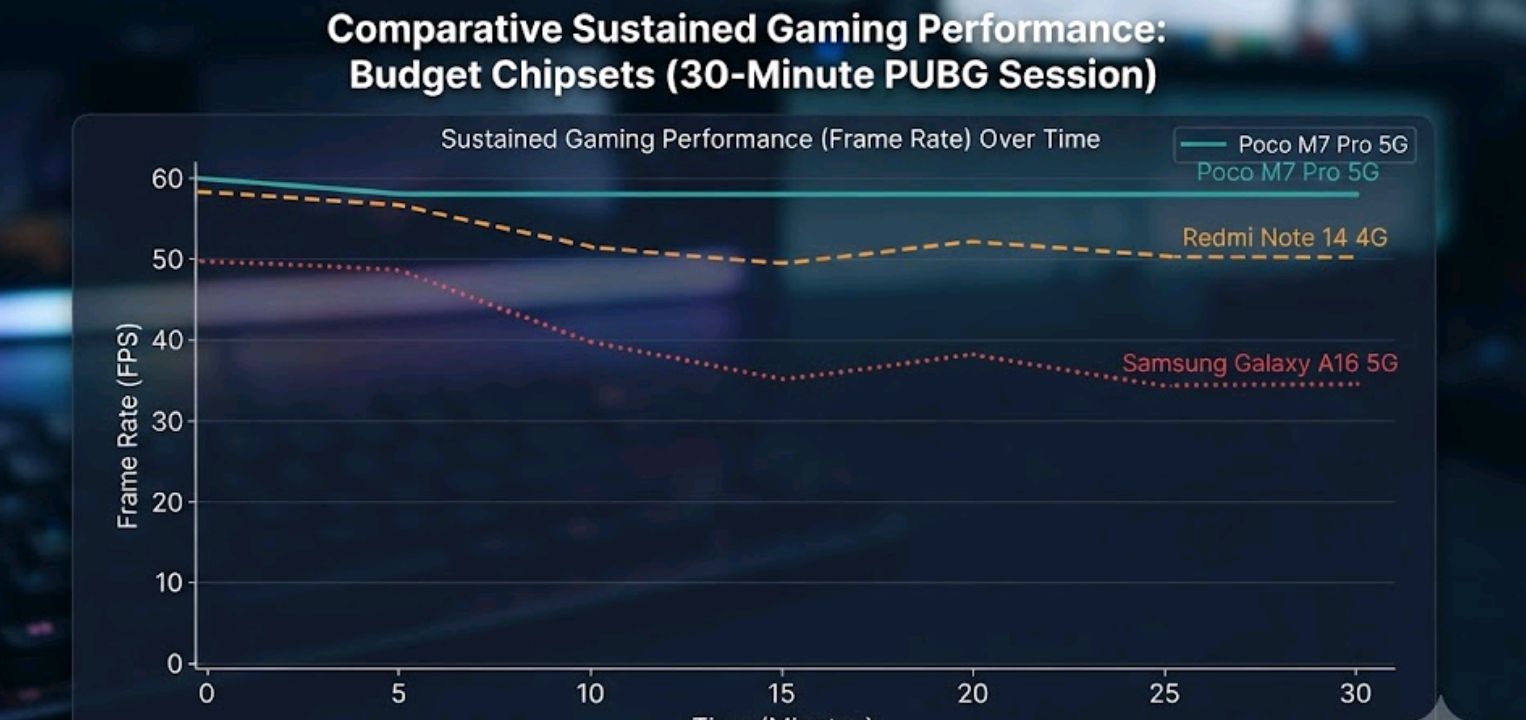
Sustained performance beats peak performance. A chipset that scores well on a single cold benchmark run but throttles under load fifteen minutes into a match is a worse gaming chip than one that holds steady at a lower peak. This is a recurring theme in user-reported performance notes on aggregators like Kimovil, where reviewers of Dimensity-based mid-rangers flag overheating-driven stuttering during extended sessions even on phones that benchmark well cold — worth checking before buying any phone in this bracket, not just the ones here.
The Dimensity 7025 Ultra in the Poco M7 Pro 5G and Redmi Note 14 5G is a standard 2+6 core layout (two Cortex-A78 performance cores paired with six Cortex-A55 efficiency cores), not the all-big-core designs found in pricier Dimensity Ultra chips. It’s a mid-tier gaming chip rather than a class-leading one — solid for COD Mobile and eFootball at medium-high settings, less comfortable with Genshin Impact at anything above low settings.
Refresh rate needs a panel that can keep up. A 120Hz display is close to standard at this price now, but the number only matters if the GPU can push frames fast enough to use it. Titles like Mobile Legends and eFootball will happily run at lower graphics presets to hit higher frame rates — worth setting manually rather than trusting auto-detect.
Battery capacity matters less than efficiency. Every phone on this list carries a 5,000mAh-class battery, so the differentiator is how efficiently the chipset and display manage power under sustained load, not the raw mAh figure.
The Picks, One at a Time
Poco M7 Pro 5G — Runs the same Dimensity 7025 Ultra platform as the pricier Redmi Note 14 5G, in a phone that’s consistently listed near $226. It’s the strongest gaming pick on this list for the money for two concrete reasons: its IMG BXM-8-256 GPU outclasses the Mali-G57/G68-series graphics in the Galaxy A16 5G and the Mali-G52 in the Tecno Spark 40, and its Cortex-A78 performance cores hold clock speed better under sustained load than the older A76 cores in the A16 5G’s chips. It also carries confirmed UFS 2.2 storage, which several phones on this list either share or leave undisclosed. The AMOLED 120Hz panel and 5,110mAh battery match its Redmi sibling closely; the tradeoff is a simpler dual-camera setup instead of the Note 14 5G’s triple-camera system.
Redmi Note 14 4G — The Helio G99 Ultra is built more for balanced daily use than gaming headroom, but it handles COD Mobile and PUBG Mobile at medium settings without major stutter, and its 5,500mAh battery is the largest here. A sensible pick if gaming is one priority among several rather than the only one.
Samsung Galaxy A16 5G — The weakest gaming chipset on this list. Most markets, including the US, get the Exynos 1330; India and Thailand ship with the Dimensity 6300 instead, per Samsung’s own regional support pages and GSMArena’s benchmark reporting on both variants. Either chip pairs with UFS 2.2 storage. It’s the only phone here backed by Samsung’s six-year OS and security update commitment, but it’s fine mainly for eFootball and turn-based or 2D titles — it struggles with anything graphically demanding, and GSMArena’s review of the Exynos variant notes it runs warm on sustained 5G data use.
Tecno Spark 40 — The budget floor of this list, and the widest availability across Nigerian retailers. The Helio G81 handles lighter titles — card games, 2D platformers, casual strategy — comfortably, but its Mali-G52 MC2 GPU will show its limits in anything pushing heavy particle effects or high polygon counts.
Redmi Note 14 5G — The same Dimensity 7025 Ultra as the Poco M7 Pro 5G, but with a stronger 108MP main camera and triple rear setup. Entry configurations list closer to $173–$200; higher RAM/storage tiers can cross $250, so check the specific configuration before buying.
Nigeria Pricing Context
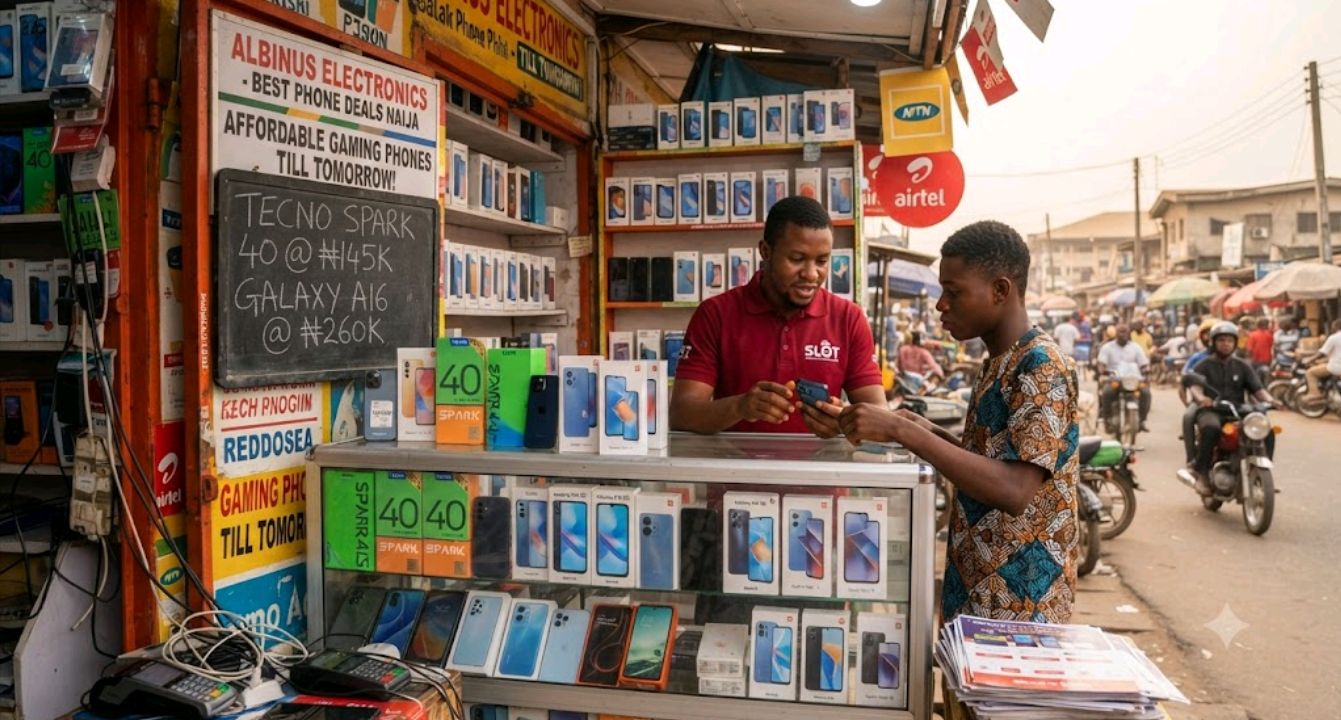
New-unit retail pricing in Nigeria, based on listings from NaijaTechGuide and Jiji.ng as of July 2026:
| Phone | Nigeria Price Range (New) |
|---|---|
| Samsung Galaxy A16 5G | ₦252,000–₦300,000 |
| Redmi Note 14 5G | ₦225,000–₦280,000 |
| Tecno Spark 40 | ₦130,000–₦190,000 |
The Poco M7 Pro 5G and Redmi Note 14 4G don’t have consistent official Nigerian retail listings at the time of writing — availability skews toward grey-market and UK-used units on Jiji and through Computer Village resellers, where pricing swings widely by condition and import batch. For those two, check current Jumia and Slot listings directly rather than relying on a fixed figure here. As with any grey-market purchase, confirm a valid IMEI and 5G band compatibility with your carrier before buying, since some import units are configured for other regions.
FAQ
Does RAM size actually affect gaming performance, or is it mostly marketing? Past 6GB, additional RAM mostly helps with keeping apps in memory for faster switching rather than boosting in-game frame rates directly. 6GB is a reasonable floor if you multitask between a game and messaging apps during play.
Is a 120Hz display worth it over 90Hz at this price? Only if the GPU underneath can sustain frame rates that high in the games you actually play. On these chipsets, most titles settle closer to 60fps in real-world use, so the extra refresh rate shows up mainly in UI scrolling and menu navigation rather than gameplay itself.
Should I prioritize MediaTek or Samsung/Qualcomm chipsets for gaming at this price? Neither brand has a universal edge under $250 — it comes down to the specific chip generation. The Dimensity 7025 Ultra in the Poco M7 Pro 5G and Redmi Note 14 5G outperforms the Exynos 1330 and Helio G81 on this list, but it’s still a mid-tier chip, not a gaming-flagship one.
Will any of these phones run demanding titles like Genshin Impact well? Expect low-to-medium settings with occasional frame drops on the Dimensity 7025 Ultra phones, and a rougher experience on the Helio G81 and Exynos 1330 models. None of these chipsets are built for open-world titles at high settings — that’s still a $400+ conversation.
How long will a 5,000mAh battery last for continuous gaming? Typically three to five hours of continuous play, depending on screen brightness, refresh rate setting, and whether mobile data or Wi-Fi stays active throughout.
If You Just Want the Answer
| If you want… | Buy… |
|---|---|
| Best gaming performance | Poco M7 Pro 5G |
| Best all-round value | Redmi Note 14 5G |
| Longest software support | Samsung Galaxy A16 5G |
| Lowest price | Tecno Spark 40 |
| Biggest battery | Redmi Note 14 4G |



Comments 0
Leave a comment