
Table of Contents
Open Table of Contents
Overview
Google’s camera-first strategy remains one of the biggest reasons Pixel phones stand out in 2026. A decade into the Pixel project, the lineup has grown into something genuinely useful across price points — from the more accessible Pixel 10a to the top-shelf Pixel 10 Pro XL, every tier has a real camera story to tell.
But “best camera Pixel” is doing a lot of work as a phrase. Best for zoom? Best for low-light video? Best if you’re on a tighter budget? Those are different phones with different answers. This post breaks it down honestly.
How We Ranked These Phones
We ranked Pixel cameras based on photo quality, zoom performance, low-light results, video capability, price, and availability for buyers in 2026. Specs were cross-checked against Google’s official product pages and major device databases. Where reviews are referenced, they’re named and linked.
Why Pixel Cameras Keep Winning
Most camera phones compete on megapixels. Google’s strategy has always leaned harder on processing — what happens after you press the shutter: HDR tone mapping, Night Sight algorithms, subject separation for portraits, and more recently, AI-assisted zoom. With the Pixel 10 series, Google continued refining the Pixel camera system rather than completely rebuilding it, pairing familiar sensor hardware with the Tensor G5 chip. That chip includes a new ISP (Image Signal Processor) specifically built to improve camera performance, with the improvement showing up most clearly in dynamic range and low-light video consistency.
The Best Google Pixel Camera Phones in 2026
1. Google Pixel 10 Pro XL — Best Overall Camera Pixel

If camera performance is the priority and budget isn’t the deciding factor, the Pixel 10 Pro XL is the clearest recommendation. The rear camera system consists of a 50MP main sensor (f/1.68, 1/1.31” sensor, 24mm equivalent focal length) with OIS, a 48MP ultrawide at f/1.7 with 123° field of view and macro focus, and a 48MP periscope telephoto at f/2.8 with 5x optical zoom. The front camera is a 42MP ultrawide with autofocus.
On the video side, it records 4K at up to 60fps natively. The 8K option exists but it’s worth being upfront: the 8K output is created through cloud-based processing rather than native 8K sensor capture. That doesn’t make it useless, but it’s a different thing than 8K from a raw sensor. The Tensor G5 chip, built on TSMC’s 3nm process, delivers the processing headroom that makes Pro Res Zoom viable. On the Pixel 10 Pro and XL, standard digital zoom handles 0.6x through 30x, and Google’s generative AI-powered Pro Res Zoom kicks in above 30x — extending the ceiling to 100x. DXOMARK’s Pixel 10 Pro XL test confirms Pro Res Zoom activates specifically at tele zoom factors between 30x and 100x, and does not apply when a face is detected in the frame.
The phone weighs 232g, which is heavier than the standard Pro model. For extended handheld shoots, that weight is noticeable.
Best for: Travel photography, portraits, serious zoom work, content creators who need the most capable camera setup available on a Pixel.
Weak point: 232g is genuinely heavy. Battery life is capable but not class-leading for its size.
2. Google Pixel 10 Pro — Best Camera in a Compact Body
Spec-for-spec, this carries the same camera system as the XL: 50MP main (f/1.68, 1/1.31”), 48MP ultrawide (f/1.7, 123° FOV, macro focus), 48MP telephoto (5x optical), and 42MP selfie camera. The distinction is entirely physical: 6.3-inch display, 207g weight, noticeably easier to hold for long shoots.
Photo output between the Pro and Pro XL is effectively identical — they share the same sensor hardware and processing pipeline. If the XL has put you off because of size, this is the direct alternative with no camera compromise.
Best for: Buyers who want full Pro camera capability without the XL’s footprint.
Weak point: Smaller battery than the XL, which matters for heavy shooters running Video Boost or extended recording sessions.
3. Google Pixel 10 — Best Camera for the Price
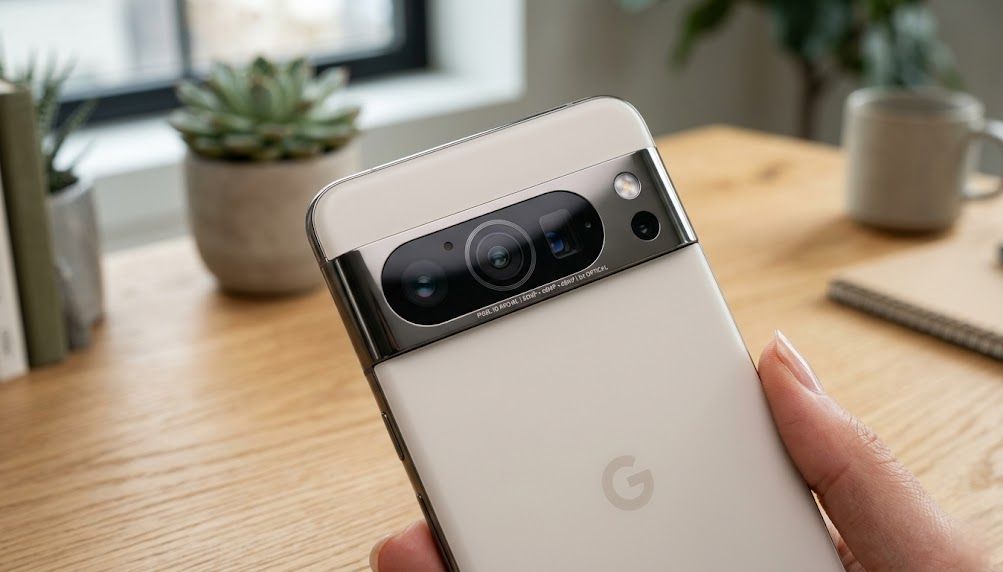
The standard Pixel 10 runs on the same Tensor G5 chip as the Pro series, in a 204g body. This generation brought a significant camera upgrade to the base model: a triple-camera system for the first time on a standard Pixel, adding a 10.8MP 5x telephoto alongside a 48MP main sensor (f/1.7) and a 13MP ultrawide. Super Res Zoom extends reach up to 20x from that telephoto baseline.
The 48MP main sensor is a step down in resolution from the Pro’s 50MP, and the ultrawide is narrower and can’t focus close-up the way the Pro’s ultrawide can — GSMArena’s review notes those as genuine regressions from previous base Pixel models. But for stills in daylight, indoor scenes, and basic portraits, output from the main camera is close enough to the Pro models that most people won’t notice. Where it steps down is in video: no Video Boost stabilisation, and Pro Res Zoom doesn’t apply to the base Pixel 10 — its zoom ceiling of 20x uses standard Super Res Zoom processing. TechRadar’s 2026 Pixel roundup describes its photos as “nearly identical in terms of color and balance” to the Pro models in standard shooting conditions.
Best for: Pixel buyers who want optical zoom and a capable main camera without the Pro price tag.
Weak point: 48MP main sensor (not 50MP like the Pro), narrower ultrawide that can’t macro focus, no Video Boost, and zoom is Super Res rather than Pro Res — the ceiling is 20x, not 100x.
4. Google Pixel 10a — Best Budget Camera Pixel
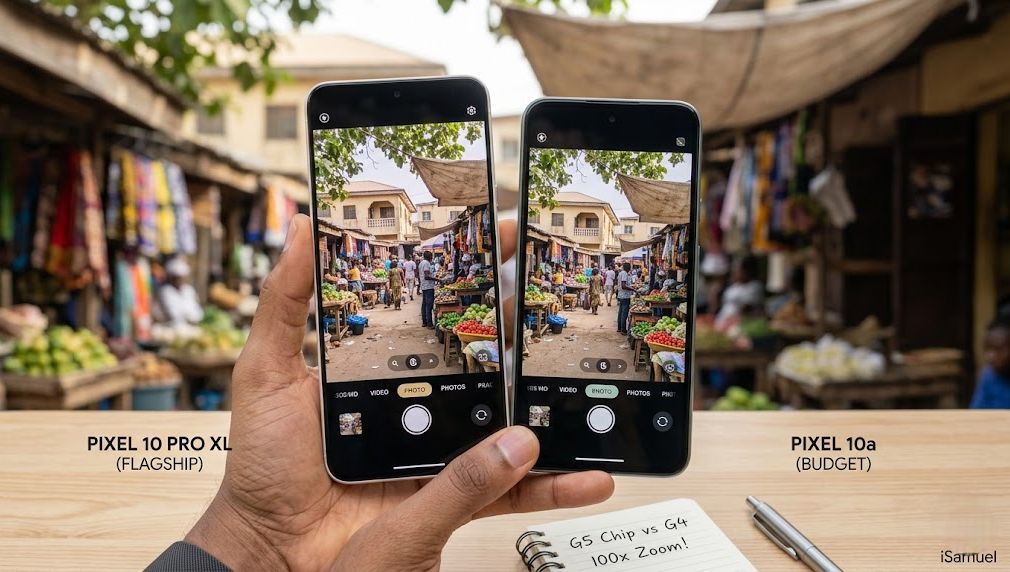
The Pixel 10a launched in March 2026. It runs on the Tensor G4 chip (one generation behind the flagship series) with 8GB RAM, and carries a 48MP main camera at f/1.7 on a 1/2” sensor with OIS, paired with a 13MP ultrawide at f/2.2. There is no telephoto lens. Video goes up to 4K at 60fps.
On paper, those specs sound limiting. In practice, independent camera coverage — including TechRadar and Digital Camera World — has consistently placed its main camera output close to the Pixel 10 Pro in controlled daylight comparisons. Where it genuinely stands out is skin tone accuracy and Night Sight: Google’s Real Tone processing, which handles a wide range of skin tones with natural colour and without overexposure, carries over fully from the flagship line. Night Sight on the 10a also performs better than most phones at this price in moderate low-light conditions.
The gaps are real though: the ultrawide is fixed-focus and can’t macro focus — that’s a Pro and base Pixel 10 feature only. No optical zoom means digital crop past 1x degrades quickly. No Video Boost. No Night Sight Video at high resolution. For content creators or buyers who zoom regularly, those absences matter.
Best for: Budget shoppers, first Pixel buyers, anyone who shoots mainly stills in good light.
Weak point: No telephoto is a hard limit. Video missing stabilisation and zoom features present on Pro models.
5. Google Pixel 9 Pro — Still a Worthy Pick
If the Pixel 10 Pro is out of reach, the Pixel 9 Pro remains a genuine camera option in 2026. The triple camera hardware (50MP main, 48MP ultrawide, 48MP 5x periscope telephoto) is the same architectural setup as the 10 Pro, just running on the older Tensor G4. Night Sight processing is still among the better results on Android.
It lacks the newer AI camera coaching features introduced with the 10 series, and the Pro Res Zoom ceiling is lower. But for everyday photography — events, travel, food, portraits — it doesn’t feel like a serious downgrade.
Best for: Buyers who find the Pixel 10 Pro out of reach but want optical zoom and Pro-tier hardware.
Weak point: Missing the G5 chip’s ISP improvements and the latest AI imaging features from the 10 series.
Quick Comparison Table
| Phone | Chipset | Main Cam | Telephoto | Video | Weight |
|---|---|---|---|---|---|
| Pixel 10 Pro XL | Tensor G5 | 50MP f/1.68, 1/1.31” | 5x optical, 100x Pro Res Zoom | 4K 60fps / 8K (upscaled) | 232g |
| Pixel 10 Pro | Tensor G5 | 50MP f/1.68, 1/1.31” | 5x optical, 100x Pro Res Zoom | 4K 60fps / 8K (upscaled) | 207g |
| Pixel 10 | Tensor G5 | 48MP f/1.7, 1/2.0” | 5x optical (10.8MP), 20x Super Res Zoom | 4K 60fps | 204g |
| Pixel 10a | Tensor G4 | 48MP f/1.7, 1/2” | None | 4K 60fps | 183g |
| Pixel 9 Pro | Tensor G4 | 50MP f/1.68 | 5x optical | 4K 60fps | 210g |
Specs sourced from Google’s official product pages and major device databases.
Camera Feature Deep Dive
Night Sight
Night Sight on the Pixel 10 Pro series handles high-dynamic-range night scenes — mixed artificial lighting, candles, street lights — with reliable shadow recovery and controlled highlights. The DXOMARK test of the Pixel 10 Pro XL highlighted its strong white balance and exposure accuracy in video at night as areas where it outperformed some competing flagships. The Pixel 10a’s Night Sight is capable in moderate low-light but falls behind the Pro models in challenging or fast-moving conditions.
Zoom
The 5x optical periscope telephoto on the Pro models and the 10.8MP 5x telephoto on the standard Pixel 10 are both the practical zoom anchor. From there, the two lineups diverge. On the Pixel 10 Pro and XL, digital zoom handles 5x through 30x as standard, and Google’s generative AI Pro Res Zoom activates above 30x — extending usable reach up to 100x. DPReview’s hands-on testing notes Pro Res Zoom doesn’t fire when a face is in the frame to avoid unnatural distortion. The honest ceiling for results worth keeping sits around 20–40x; 100x is the outer edge where AI reconstruction does heavy lifting. On the standard Pixel 10, zoom tops out at 20x via Super Res Zoom — no Pro Res processing, no AI generative enhancement. Both the Pixel 10 and Pixel 10a sit at the same zoom ceiling, though the Pixel 10 gets there via optical then digital, while the 10a is digital-only from 1x.
Portrait and Skin Tones
Google’s portrait processing has improved noticeably over the past two generations in handling a wider range of skin tones. Subject separation is generally clean without the edge-halo issues that show up occasionally in Samsung’s processing at similar price points.
Video

Video is where the gap between Pro and non-Pro models is sharpest. Video Boost on the Pixel 10 Pro and XL delivers significantly smoother, more cinematic stabilised footage compared to standard EIS on the Pixel 10 and 10a. The 8K option on Pro models is created through cloud-based processing rather than native sensor capture — a useful distinction if that spec matters to your workflow. The Pixel 10 and 10a record 4K at 60fps, which is solid for casual content but below the Pro tier for professional or creator use.
Which Pixel Camera Phone Should You Buy?
- Absolute best camera available on a Pixel → Pixel 10 Pro XL
- Same camera, smaller and lighter → Pixel 10 Pro
- Optical zoom and capable camera without the Pro price → Pixel 10
- Budget is the priority, stills in good light are the main use → Pixel 10a
- Buying used or on a tight flagship budget → Pixel 9 Pro
FAQ
Is the Google Pixel 10 Pro better for cameras than the Samsung Galaxy S26?
The two phones approach photography differently. The Pixel 10 Pro is noted for more natural colour reproduction and consistent processing across lighting conditions. The Galaxy S26 Ultra uses a 200MP main sensor and is often preferred for maximum detail in bright daylight and for telephoto reach at the highest end. In testing across multiple reviewers, both are competitive, and the “better” result often depends on shooting style rather than one phone being objectively superior across the board. For a detailed breakdown, see our Pixel 10 vs Galaxy S26 comparison.
Does the Pixel 10a have a good enough camera for content creation?
For Instagram, short-form video, and casual content: yes, comfortably. The main camera produces strong stills, and Night Sight handles moderate low-light better than most phones at its price. Where it falls short for creators is video stabilisation (no Video Boost) and zoom — digital-only past 1x is a real limitation for anyone who regularly needs to pull focus on distant subjects.
How does the Pixel 10 Pro compare to the iPhone 17 Pro for cameras?
Both sit at the top of their respective platforms. The iPhone 17 Pro and Pro Max are widely considered benchmarks for mobile video, particularly for cinematic shooting. For stills, the Pixel 10 Pro’s dynamic range and mixed-light consistency is rated alongside or above the iPhone in most independent reviews. See our iPhone camera comparison for more.
What is the maximum zoom on the Pixel 10 Pro vs the standard Pixel 10?
The Pixel 10 Pro and Pro XL can reach 100x using Google’s Pro Res Zoom processing at higher zoom levels — the feature activates above 30x and uses the Tensor G5 chip to reconstruct detail at high zoom levels. Below 30x, standard digital zoom applies. The standard Pixel 10 tops out at 20x via Super Res Zoom, without the generative AI layer. In practical use, both phones produce their best zoom results well below their respective ceilings: 10–40x on the Pro models, and up to around 10x on the standard Pixel 10.
Is the 8K video on the Pixel 10 Pro native?
No. The 8K output on the Pixel 10 Pro and XL is created through cloud-based processing rather than native 8K sensor capture. That still produces a higher-resolution output than 4K in many conditions, but it differs from 8K on phones that record natively at that resolution.
Are Pixel phones available in Nigeria?
Google Pixel phones are not officially distributed through Google in Nigeria, but they’re available through grey-market importers and online marketplaces like Jumia. Pricing varies significantly and manufacturer warranty coverage is typically not included — factor that into the buying decision, especially for higher-end models. Our best Google Pixel phones guide covers availability and pricing context in more detail.
What is the realistic price of Pixel phones in Nigeria?
The Pixel 10a launched at $499 USD, and with grey-market import premiums in Nigeria, expect to pay well above ₦600,000 for a new unit depending on the seller and exchange rate at time of purchase. The Pixel 10 Pro and Pro XL sit considerably higher. For buyers on a tighter budget, a used Pixel 9 or Pixel 9 Pro from a trusted reseller is often the more realistic entry point into the Pixel camera experience.

Comments 0
Leave a comment