Table of Contents
Open Table of Contents
- Samsung Galaxy vs Apple Ecosystem — Honest 2026 Comparison
- Hardware: Premium Has Two Different Definitions
- The Ecosystem Experience: Where It Gets Personal
- AI Features: Galaxy AI vs Apple Intelligence
- Camera: Two Different Theories of Good Photography
- The Little Things You Notice After Six Months
- Price and Real Cost of Ownership
- Gaming: More Equal Than It Used to Be
- Which One Is Right for You
- FAQ
Samsung Galaxy vs Apple Ecosystem — Honest 2026 Comparison
I’ve used both. Not for a week-long review. For years, switching back and forth until I had a clear opinion about what each side actually gets right — and where each one quietly, consistently frustrates you.
Most ecosystem comparisons end up being spec comparisons with better lighting. That’s not what this is. Specs are easy to look up. What’s harder to find is an honest account of what it feels like to depend on these systems every single day — for work, for travel, for the $1,200 question of whether you made the right call.
So here’s the real version.
Hardware: Premium Has Two Different Definitions
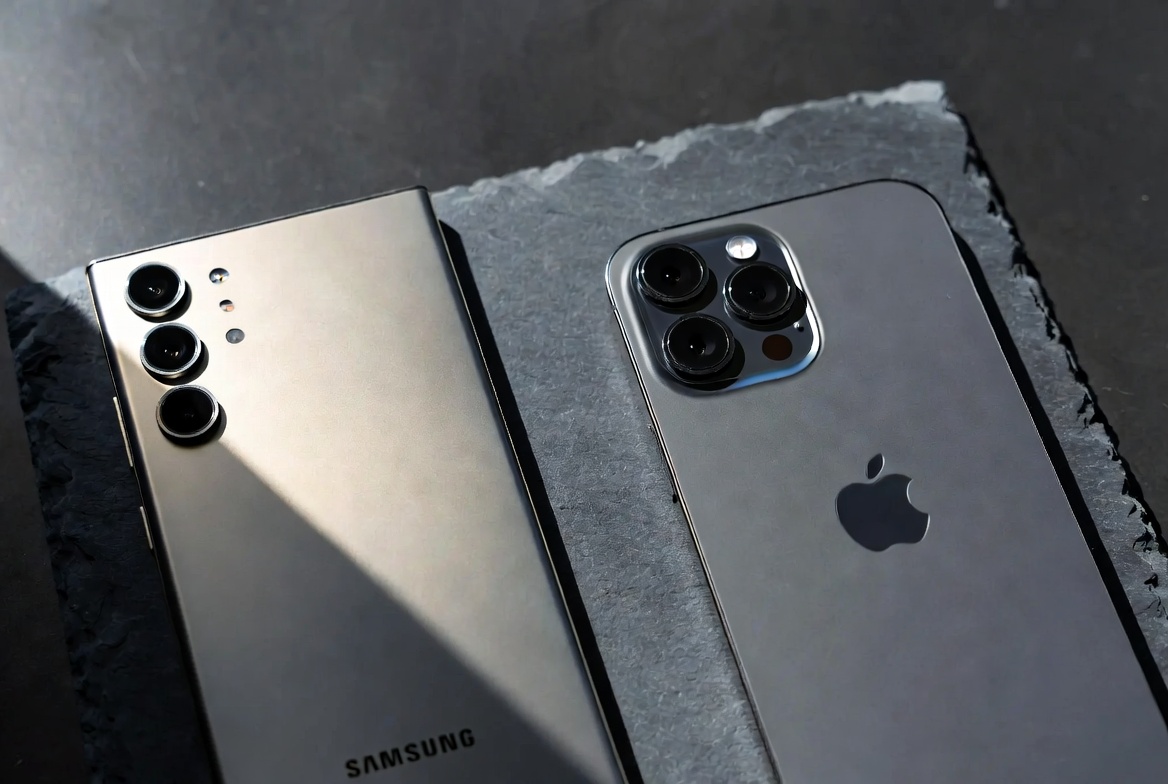
Pick up an iPhone 17 Pro Max and you feel it immediately. The titanium frame, the weight distribution, the way the Action Button responds — Apple has spent years tuning the physical experience of holding the thing, and it shows. Nothing about it feels incidental.
Samsung’s Galaxy S26 Ultra makes a different argument. More screen. Built-in S Pen. A 200MP main sensor. A display that gets measurably brighter at peak output. Where Apple says “this is the best version of one thing,” Samsung says “here’s everything, configured exactly how you want it.” If your workflow involves handwritten notes, sketches, or annotating documents directly on your phone, there’s genuinely nothing on the market that competes with the S Pen experience.
The mid-range gap is where Samsung pulls meaningfully ahead. The Galaxy A56 at $449 delivers a camera system, display quality, and processing power that would have been a flagship story two or three years ago. Apple’s iPhone 16e at $599 is solid — but you’re absorbing a premium that doesn’t always show up where you’d expect it to. For a full breakdown of where Samsung sits across budget tiers, the top Samsung phones for camera quality in 2026 covers it in detail.
Verdict: Samsung wins on value and versatility. Apple wins on build refinement and physical consistency.
The Ecosystem Experience: Where It Gets Personal
This is where the comparison stops being about phones and starts being about whether the tech in your life works together — or just works separately and occasionally talks to each other.
Apple’s Ecosystem: Tight by Design
AirDrop between an iPhone and a Mac is so fast and reliable that you stop thinking about it within a week. That’s the whole point. Continuity Camera, Handoff, Universal Clipboard, iMessage synced across every device — Apple’s ecosystem earns its reputation because it quietly disappears. The friction is so low you only notice it when you’re briefly on someone else’s device and suddenly have to think about how to move a file.
The cost of that seamlessness is genuine. Apple Watch only works with iPhone — no partial compatibility, no workaround, hard lock. iMessage only delivers its full experience inside Apple’s walls. If someone in your group chat switches to Android, you know about it immediately. So does everyone else in the thread.
Samsung’s Ecosystem: Ambitious, With Drafty Windows
Samsung’s Galaxy ecosystem covers a lot of ground — Galaxy Watch, Galaxy Buds, Samsung DeX, Samsung Flow, Link to Windows. The ambition is real. But if Apple’s ecosystem is a sealed room with perfect acoustics, Samsung’s is a well-furnished apartment where one window occasionally lets a draft in.
Quick Share vs AirDrop — Quick Share works fine between Galaxy devices. The moment you try to Quick Share to a non-Samsung Android phone or a Windows laptop, you hit friction that shouldn’t exist in 2026. You end up emailing yourself files occasionally. That’s a small thing that happens often enough to notice.
File transfers in general — Android gives you full file system access. You plug in a USB cable, your phone mounts as a drive, you drag files like it’s 2010. On iPhone, file transfer still routes through the Files app’s limited export options for most content. Android wins this cleanly.
DeX is the real wild card. Plug your Galaxy phone into a monitor and you get a functional desktop environment — resizable windows, mouse cursor support, proper multitasking. Apple has no equivalent. For people who travel frequently or want to reduce the number of devices they carry, DeX is not a gimmick. It’s a genuine capability gap.
| Feature | Samsung Galaxy | Apple |
|---|---|---|
| Cross-device file sharing | Quick Share (strong within Galaxy, weaker cross-brand) | AirDrop (seamless, Apple-to-Apple only) |
| Smartwatch compatibility | Galaxy Watch (also pairs with other Android phones) | Apple Watch (iPhone only, no exceptions) |
| Desktop mode | DeX — real, functional desktop environment | No equivalent |
| Notification control | Per-channel granularity, priority tiers, fine-grained | Improved, but still coarser than Android |
| File system access | Full access via USB or file manager | Sandboxed — Files app only, limited USB transfer |
| Bloatware | Present on most carrier variants | Minimal — but Apple’s own apps can’t be fully removed |
| Repairability | Improving — iFixit scores rising steadily | Improved, but Genuine Parts pairing still exists |
| USB-C throughput | USB 3.2 speeds on flagships, wide peripheral support | USB 3.2 on Pro models — some features still Apple-gated |
| Device tracking | SmartThings Find (solid, improving) | Find My (class-leading, deeply integrated) |
The Notification Problem Nobody Covers Enough
Android’s notification system is meaningfully better than iOS in 2026. Per-app notification channels, category-level control, priority tiers, silent notifications that appear when you check without buzzing your wrist — these matter if you receive high notification volume daily.
iOS has improved significantly over the last two major releases. But it still operates on a model that feels blunt compared to Android’s precision. If you’ve spent years on Android and switch to iPhone, the first two weeks of notification management are a genuine adjustment. Some people never fully stop missing it.
AI Features: Galaxy AI vs Apple Intelligence
Samsung spent much of late 2025 shipping Galaxy AI features that were immediately practical — Live Translate during phone calls in real time, Note Assist for summarizing long documents, Circle to Search for pulling up information about anything on screen. By early 2026 these features had matured into things you use without thinking about them.
Apple spent that same period working through well-documented challenges with Apple Intelligence — uneven Siri performance in the initial builds, delayed features, and criticism over the rollout’s execution. The 2026 software updates have addressed most of those issues and Apple Intelligence has settled into a more reliable state. But Samsung integrated AI into daily use faster, and that head start still registers in day-to-day comparison.
Camera: Two Different Theories of Good Photography
This deserves its own deep-dive, and I wrote one — the full Galaxy S26 Ultra vs iPhone 17 Pro Max vs Pixel 10 Pro camera comparison goes into real-world conditions and actual side-by-sides. The short version for this article:
Samsung’s 200MP sensor captures extraordinary detail in good light. In auto mode it processes aggressively — images look sharp, punchy, and optimized for social media, which can occasionally tip into over-processing if you’re after natural rendering.
Apple’s camera system produces more consistent color science across mixed lighting. Skin tones land more accurately. For video — ProRes recording, Cinematic mode, content creation at a professional level — the iPhone’s pipeline integrates more cleanly into a serious editing workflow without additional color correction work.
For where Apple’s lineup lands on camera performance at each tier, the top iPhones for camera in 2026 is worth reading before you decide.
The Little Things You Notice After Six Months
This is the part that doesn’t show up in reviews. Nobody tells you about it until you’ve actually lived there.
The AirPods switching tax. If you use AirPods with an iPhone, the automatic device switching is genuinely magical until it switches mid-sentence on a call because your Mac woke up. Galaxy Buds handle this more predictably — you choose where they connect, and they stay. Small thing. Comes up daily.
FaceTime as social infrastructure. In many parts of the world — the US especially — FaceTime is how families stay connected. It’s not a feature comparison anymore, it’s a habit. Switching to Android means convincing your parents to install WhatsApp or Google Meet. That friction is real and it’s underestimated every time someone writes a “just switch!” article.
Samsung keyboard sync across devices. Samsung’s keyboard doesn’t sync clipboard history or learned words across your Samsung tablet and phone as cleanly as Apple’s Universal Clipboard does across Mac, iPhone, and iPad. If you switch between a Galaxy phone and a Galaxy Tab regularly, you’ll type the same correction twice more often than you should.
Password manager behavior. On iPhone, iCloud Keychain is invisible — it fills passwords before you consciously think about asking. On Samsung, you’re dependent on a third-party app or Google Password Manager, which works but requires one more tap in the flow. Over a year, those taps add up in a way that’s hard to quantify but easy to feel.
Find My vs SmartThings Find. Apple’s Find My network — crowdsourced location tracking through hundreds of millions of Apple devices — is still class-leading. SmartThings Find has improved, but the network density difference is noticeable if you’ve ever actually needed to track down a lost device in a non-obvious location.
Family ecosystem gravity. This is the one nobody accounts for. If your partner, kids, or parents are on iPhone, there’s a pull toward staying on iPhone that has nothing to do with features. Shared albums, location sharing through Find My, iMessage threads — these create an invisible cost to leaving that compounds with every family member on Apple hardware.
These are the things that tip decisions that benchmarks never will.
Price and Real Cost of Ownership
| Device | Launch Price | Estimated 2-Year Resale |
|---|---|---|
| iPhone 17 Pro Max | $1,199 | ~$700–750 |
| Galaxy S26 Ultra | $1,299 | ~$500–580 |
| iPhone 16 | $799 | ~$480–520 |
| Galaxy S26 | $899 | ~$380–440 |
| Galaxy A56 | $449 | ~$200–240 |
| iPhone 16e | $599 | ~$330–370 |
iPhones hold value measurably better than Samsung devices at every tier. If you upgrade every two years and sell your old device, that resale difference materially closes the sticker price gap. A $400 difference at launch can shrink to under $100 in actual two-year cost when you account for trade-in.
Samsung gives you more hardware per dollar at launch. Apple gives you a better return on exit. Both things are simultaneously true, and which one matters more depends entirely on how you buy phones.
Gaming: More Equal Than It Used to Be
Apple’s A18 Pro chip in the iPhone 17 family is an exceptional piece of silicon — GPU performance figures that were laptop territory two years ago. Premium game ports still land on the App Store first in many cases, and the raw hardware headroom is real for demanding titles.
Android gaming has closed the gap in ways that matter: broader AAA title availability, better controller support infrastructure, and the ability to install titles and emulators without workarounds. If gaming is your primary use case, it’s also worth asking whether a dedicated gaming phone makes more sense than either ecosystem’s flagship — the RedMagic vs ROG Phone comparison covers exactly that question if you’re leaning that direction.
Which One Is Right for You
Go Samsung if:
- You use a Windows PC daily — the Galaxy integration there is genuinely underrated
- Customization and control matter more to you than seamlessness
- You want real mid-range value without paying a brand premium
- S Pen or DeX fits your actual workflow, not just sounds cool
- You want full file system access and USB-C versatility without Apple’s restrictions
Go Apple if:
- You already own a Mac, iPad, or Apple Watch — the compounding integration is real
- You shoot video professionally and want a pipeline that works cleanly in post
- Resale value is part of how you calculate total cost of ownership
- You want software support that reliably runs 6+ years without tracking it yourself
- iMessage, FaceTime, and Find My are already how your family and friends operate
FAQ
Does Samsung now match Apple on long-term software support? Essentially yes. Samsung’s Galaxy S flagships now ship with a 7-year OS update commitment. Apple has historically supported iPhones for 6 or more years. This parity is recent — Samsung’s update track record was meaningfully worse until a few years ago — and it changes the long-term value math considerably.
Is Galaxy AI more useful than Apple Intelligence right now? In day-to-day practical terms, yes — Galaxy AI features like Live Translate and Circle to Search shipped earlier and integrated more smoothly into normal use. Apple Intelligence has recovered from its difficult early rollout and is now genuinely capable, but Samsung established the head start on features that feel immediately useful rather than still experimental.
Can Samsung and Apple devices work together in 2026? Better than they used to. RCS messaging has largely resolved the cross-platform messaging gap. Cross-platform apps and password managers reduce friction for mixed households. The wall is lower than it’s been in years — though Apple’s core features like AirDrop, Handoff, and iMessage still only fully function within Apple’s own hardware.
Which ecosystem handles privacy better? Apple’s privacy architecture is more deeply embedded at the OS level — on-device processing as a baseline, App Tracking Transparency, App Store privacy labels. Samsung’s Knox security is enterprise-grade and strong, particularly for business use. But Apple’s privacy model is more consistent and systematic at the consumer level.
What’s the actual deal with Samsung bloatware? It exists, and it’s more noticeable on carrier variants. Most Samsung and carrier pre-installed apps can be disabled even when they can’t be deleted. Samsung’s own apps — Samsung Health, Samsung Pay — have improved enough that some are worth keeping. Bixby still trails behind Google Assistant and Siri in broader day-to-day usefulness, though it handles device control commands reliably. It’s a friction point for the first week; most people work around it after that.
Which holds its resale value better? Apple, and it’s not particularly close. iPhones retain a higher percentage of launch price at both the 12-month and 24-month marks across every tier. If you trade in or sell before buying new, that gap translates to real money and deserves to be part of your actual cost calculation before you commit.
Is it worth switching ecosystems in 2026? Only if your current setup is creating genuine, recurring friction — not because you’re curious about what the other side feels like. The switching cost is real: data migration, rebuilding habits, and losing features that don’t have direct equivalents on the other platform. If you’re frustrated where you are, both ecosystems are strong enough in 2026 that the jump is worth making. If you’re content, the gap between them is smaller than the internet suggests.
Both ecosystems are excellent in 2026. The honest answer to “which is better” is almost always “it depends on you” — but that doesn’t have to be a vague cop-out if you actually know what to look for in your own life.
Pick the trade-offs that fit how you work, not the ones that look better in benchmark graphs.
And go hold both phones in a store before you decide. Sounds obvious. Most people still skip it.